Published Oct 10, 2026
Reverse Video Search Statistics 2026 Report

By the team of ReverseVideoSearch.io
Original research on search results, device usage and submitted platforms.
About two in three completed automated searches found a valid match in ReverseVideoSearch.io’s reporting snapshot. We found matching indexed content in 35 of 53 searches. Matches outnumbered searches with no result by almost two to one, although finding a match doesn’t necessarily identify the original upload.
We also analyzed more than 43,000 anonymous video URL submissions to see which device categories were used and where submitted links came from. These are separate usage records, not the sample behind the match rate. We’re sharing aggregate, non-sensitive product data without publishing customer content or individual search histories.
Key findings at a glance
| Finding | What the data shows |
|---|---|
| About two in three automated searches found a match | 35 of 53 completed automated lookups returned at least one valid result. |
| Most URL-based searches came from phones | Mobile devices accounted for approximately 56.7% of activity in the combined usage datasets. |
| X submissions outnumbered YouTube submissions by almost three to one | Identifiable X-related URLs appeared approximately 2.75 times as often as YouTube-related URLs in the available exports. |
| Six mainstream platforms accounted for just over half of submissions | X, YouTube, Instagram, Reddit, TikTok and Facebook together represented approximately 51.3% of the combined submission volume. |
What is the success rate of reverse video search?
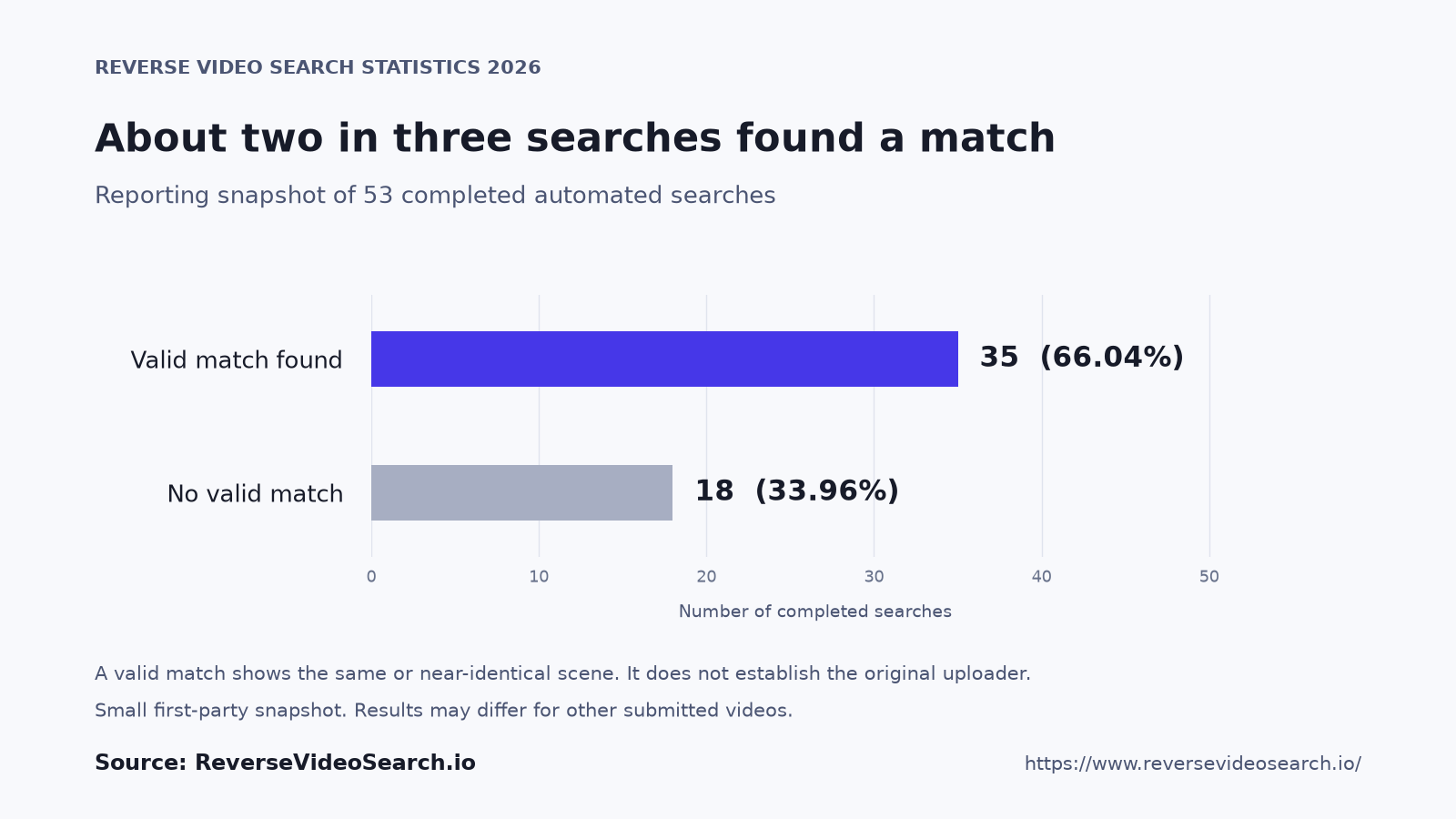
In the snapshot analyzed for this report, 35 of 53 completed automated searches found at least one valid visual match. That works out to 66.04%, or about two in three.
| Automated search outcome | Searches | Share |
|---|---|---|
| At least one valid match found | 35 | 66.04% |
| No valid match found | 18 | 33.96% |
| Total | 53 | 100% |
Source: ReverseVideoSearch.io, snapshot of 53 completed automated lookups.
Finding a match was the more common outcome: 35 searches found one, while 18 did not. That’s almost two successful searches for every search without a match.
All 53 searches ran to completion. The 18 searches with no match weren’t technical failures; they finished without finding a valid result. Free manual searches, processing failures, cancelled or incomplete orders, and internal tests are excluded.
What counts as a successful search?
We count a search as successful when it returns at least one exact or near-exact visual match from the submitted video.
The result has to show the same scene. A crop, a color adjustment or a change in image quality can still qualify. A different image of a similar person or object does not.
The calculation is:
Match rate (%) = (completed automated searches with at least one valid match ÷ all eligible completed automated searches) × 100.
One valid match is enough. A search returning several matching pages still counts as one successful search.
Does a match identify the original source?
Not necessarily. The result might be the original upload, but it could also be a repost, a mirror or another indexed page showing the same content.
A match gives you somewhere to investigate. Establishing who uploaded the video first is a separate step. This report doesn’t measure how often the original uploader was verified, so 66.04% is a match rate, not an original-source discovery rate.
Why this is a snapshot, not a lifetime success rate
We keep customer lookup records for only a short period. As older records are deleted and new searches come in, the group of searches available to measure changes.
The 66.04% figure describes the searches available when we captured this snapshot. It isn’t an average of every search the service has ever completed.
We’ve seen the rate approach 75% at other times, but that figure comes from day-to-day observation. The data published here covers 35 matches from 53 searches. With a sample this size, a different group of submitted videos could produce a different percentage.
Most URL-based reverse video searches came from phones
Mobile devices accounted for approximately 56.7% of URL-based reverse video search activity in the combined usage datasets. Desktop came next at 41.9%, followed by tablets at 1.4%.
| Device category | Approximate share |
|---|---|
| Mobile | 56.7% |
| Desktop | 41.9% |
| Tablet | 1.4% |
Source: ReverseVideoSearch.io anonymous URL-submission data. Combined percentages are weighted estimates; see the methodology below.
Phones were the majority in both datasets, accounting for 53.93% in one and 58.94% in the other.
The device category is counted anonymously when someone submits a video URL. It isn’t linked to an IP address, a persistent device identity or a customer profile.
These figures cover the URL-input workflow, not every search on the service. They also don’t tell us which app someone was using before submitting a link.
X submissions outnumbered YouTube submissions by almost three to one
X-related video URLs appeared approximately 2.75 times as often as YouTube-related URLs in the available domain exports.
After grouping identifiable related hostnames, we counted 11,699 X-related submissions, compared with 4,258 from YouTube.
| Platform | Recorded submissions | Approximate share |
|---|---|---|
| X | 11,699 | 27.2% |
| YouTube | 4,258 | 9.9% |
| 2,093 | 4.9% | |
| 1,688 | 3.9% | |
| TikTok | 1,404 | 3.3% |
| 921 | 2.1% | |
| Combined | 22,063 | 51.3% |
Source: ReverseVideoSearch.io domain exports. Counts include identifiable related hostnames present in the exports. Shares use the approximate total across both datasets.
X was the most frequently submitted mainstream platform. Together, X and YouTube accounted for approximately 37.1% of submissions. The six platforms listed above made up just over half.
The comparison tells us where submitted links came from. It doesn’t tell us why people searched, whether X videos were harder to identify, or which platform had the best match rate.
We’ve named mainstream platforms in the public table. Other domain categories still count toward the totals and percentages.
Roughly one in five submissions came from outside the top 50 domains
The 50 most frequently submitted domains accounted for about 78% of submissions in one dataset and 82% in the other.
That left approximately 18% to 22% outside each dataset’s top 50, or roughly one in five submissions.
Each dataset has its own top 50. These figures describe those two rankings separately, not a single combined ranking of platforms.
Methodology and limitations
What we measured
The search-outcome sample contains 53 completed automated lookups available when we captured the reporting snapshot. For each search, we counted whether it returned at least one valid match.
The usage analysis combines two compatible production datasets covering more than 43,000 anonymous video URL submissions. We used these records to calculate device shares and submitted-platform totals.
The match rate comes from the 53 completed lookups, not the 43,000-plus submissions. The exports do not specify collection dates, so we have not assigned a shared reporting period to these datasets.
Which records were included?
The search sample contains real, fully completed automated customer lookups. Free manual searches, technical processing failures, cancelled or incomplete orders, and internal tests are excluded.
Known internal tests, bot activity and duplicate submission events are excluded from the usage statistics.
The usage totals count submission events rather than unique people or videos.
How we calculated the usage figures
The exports provide counts and rounded percentages, but not exact overall submission totals. Together, those figures indicate slightly more than 43,000 submissions.
For that reason, combined usage percentages are approximate. We weighted device shares by each dataset’s estimated size rather than giving both datasets equal weight.
For platform totals, we grouped related hostnames only where the connection was clear. We didn’t assign a domain to a platform just because the names looked similar.
The domain exports contain only the leading domains. Smaller related hostnames outside those exports may be missing from a platform’s count, while the overall denominator still includes all eligible submissions.
Privacy
The usage statistics are collected anonymously, and this report shares only aggregated, non-sensitive product data.
We don’t publish customer videos, extracted frames, complete submitted URLs, filenames, account details, IP addresses or individual search histories. Customer lookup records are kept briefly to operate the service, not retained as a long-term behavioral history.
What these results can and cannot tell us
This is research from our own service. It isn’t a comparison of competing tools or a representative sample of everyone who uses reverse video search.
The 53-search snapshot is small. It tells us what happened in that group of searches, not what every future search will return. A valid match also doesn’t establish who uploaded the video first.
The usage figures describe submitted links and broad device categories. They don’t measure platform popularity across the internet or explain why someone wanted to find a video.
Citation-ready findings
You’re welcome to quote, share or build on this research. The summaries below are ready to use in articles, guides and other projects, with credit and a link to ReverseVideoSearch.io.
On whether reverse video search works:
ReverseVideoSearch.io found at least one valid visual match in about two out of three completed automated searches in the snapshot analyzed for this report: 35 matches from 53 eligible lookups.
On mobile usage:
Approximately 56.7% of URL-based reverse video search activity came from mobile devices in ReverseVideoSearch.io’s analysis of more than 43,000 anonymous video URL submissions.
On submitted platforms:
Across ReverseVideoSearch.io’s available domain exports, identifiable X-related video URL submissions outnumbered YouTube-related submissions by approximately 2.75 to one.
Cite or reuse this research
These findings and tables are openly available to cite, share and adapt, including for commercial use, with attribution and a link to ReverseVideoSearch.io. Please retain this credit when quoting, paraphrasing or building on the research. Our homepage (root domain) is the preferred link destination, as the URL structure of our resources may be updated.
We also appreciate acknowledgment when the findings inform your recommendations, product features or workflows.
Download the chart and data
Reuse the search-outcome chart or download the aggregate figures from the tables above. The CSV includes metric definitions and distinguishes the 53-search sample from the separate URL-submission datasets. It contains no customer-level records. The attribution terms above apply to both downloads.